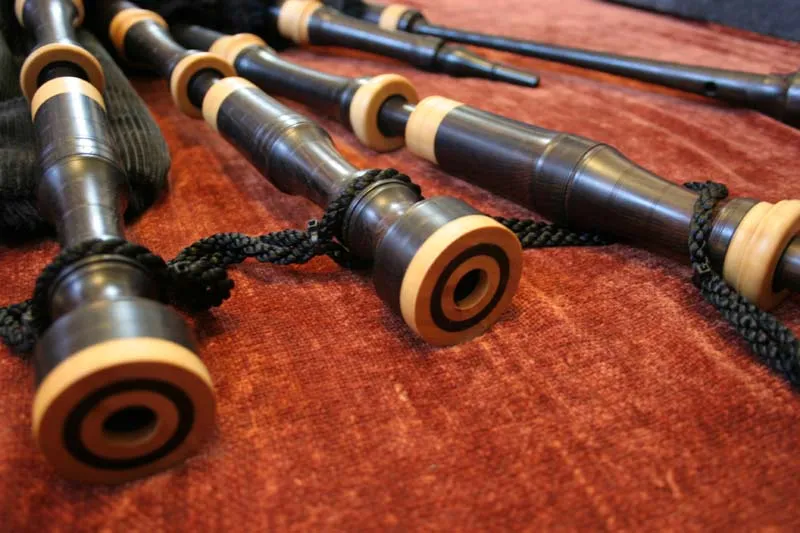
African Blackwood
The traditional wood for the Highland pipe. Very dense and very hard, and the brightest of the woods I use.
The wood is the first thing we decide together, and the question I'm asked most is how it changes the sound.
Every wood brings something of its own to a set. As a rule, the denser and harder the timber, the brighter the voice: African Blackwood sits at the bright end of the range, maple at the warm end.
The wood is only part of the story, though. How thick I leave the walls, the shape of the sound chamber and the choice of reeds all affect how bright or warm a set sounds, and give it its character. In the end, what you hear is the whole instrument, not just the timber.
| Wood | Density | Janka hardness |
|---|---|---|
| African Blackwood Brighter | 1,270 kg/m³ | 3,670 lbf |
| Cocobolo | 1,095 kg/m³ | 2,960 lbf |
| Bois d'arc | 855 kg/m³ | 2,620 lbf |
| Maple Warmer | 705 kg/m³ | 1,450 lbf |
Density and hardness are only part of the picture. Three more measurements describe how a wood behaves when it vibrates:
| Wood | Speed of sound | Stiffness |
|---|---|---|
| African Blackwood | about 3,760 m/s | 17.95 GPa |
| Cocobolo | about 4,130 m/s | 18.7 GPa |
| Bois d'arc | about 3,690 m/s | 11.64 GPa |
| Maple | about 4,230 m/s | 12.62 GPa |
Notice that the order changes. Maple is the lightest of the four, yet it carries sound the fastest, because it's stiff for its weight. Blackwood is very stiff too, but its weight slows a vibration down. It's one more reason I say a set's voice is never down to the wood alone.
There's also the question of where a bagpipe's sound comes from. Most of it is made by the column of air inside the bore, set going by the reed, rather than by the wood ringing like the soundboard of a guitar. Studies of clarinets, recorders and organ pipes have found that the walls themselves usually change the sound only a little, while the surface and porosity of the bore can make a measurable difference. Dense woods take a very smooth, stable bore, which may be part of why they sound the way they do.
The traditional wood for the Highland pipe. Very dense and very hard, and the brightest of the woods I use.
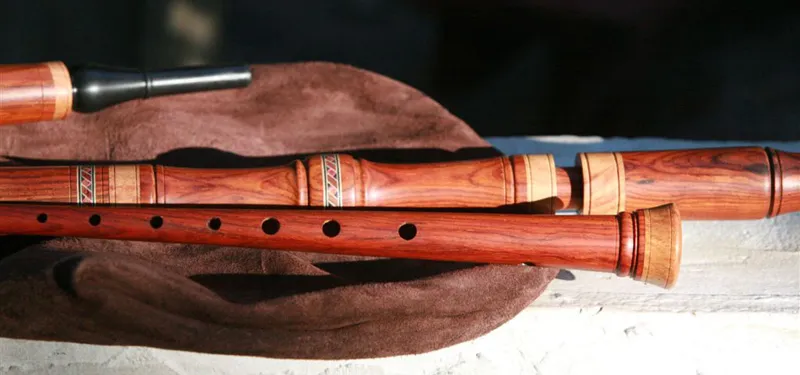
A dense rosewood with a rich red-orange grain. I've used it for medieval great pipes, with Afzelia mounts.
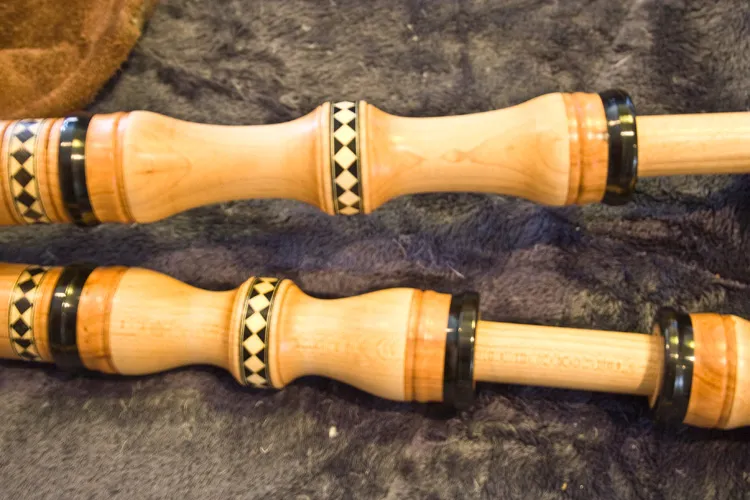
Pale, often with a curly figure, and at the warm end of the scale. Lovely with contrasting inlay.
Also called Osage orange or horse apple. A hard, dense, golden wood that I offer for practice chanters.
Practice chanters can be made in any of these woods. See the price list.
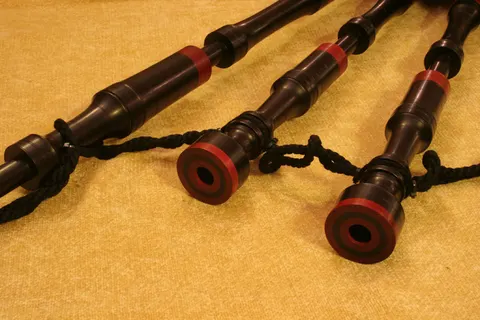
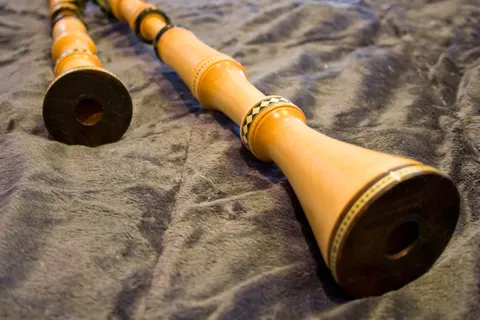
The mounts are the rings and ferrules at the joints and drone ends. I turn them from a material that suits the wood: lemonwood or pink ivory against African Blackwood; horn, water buffalo, olive wood or Afzelia on the medieval pipes.
For drone end caps I like Texas Ebony. It's extremely hard, so it stands up well to the knocks a drone end takes.
Inlay is matched to the tones of the wood. On some sets I'll combine two styles, or two mount materials, for something a little more special.
Tell me the sound you're after and how you'll be playing, and we'll choose the wood and mounts together.